
Views: 0 Author: Site Editor Publish Time: 2026-11-04 Origin: Site


The main difference between an industrial robot vacuum and a commercial robot vacuum is their intended application. Industrial models are commonly positioned for warehouses, factories, and logistics facilities. Commercial models often target offices, hotels, retail properties, and other shared buildings.
However, the category name does not establish a machine’s cleaning capacity, filtration, navigation, or environmental suitability. Commercial robots are not household appliances, and industrial robots are not automatically suitable for every type of production waste.
Choose the exact model around the floor, debris, operating conditions, and cleaning result required.
Table of Contents
The following table compares application priorities rather than guaranteed features.
Evaluation area | Commercial-site priorities | Industrial-site priorities |
|---|---|---|
Typical locations | Offices, hotels, shops, and shared indoor facilities | Warehouses, factories, and logistics areas |
Floor assessment | Carpet, hard floors, transitions, and appearance | Floor texture, coatings, joints, and operating conditions |
Debris assessment | Dust, hair, tracked-in dirt, and other permitted material | Quantity and characteristics of production or packaging debris |
Access | Furniture, guest areas, doors, and narrow corridors | Racking, pallets, machinery, and changing storage layouts |
Traffic | Occupants, customers, and service carts | Workers, handling equipment, and industrial traffic |
Daily workflow | Suitable timing, noise, coverage, and staff usability | Coverage, collection capacity, servicing, and production schedules |
Verification | Test the proposed configuration on site | Test the proposed configuration on site |
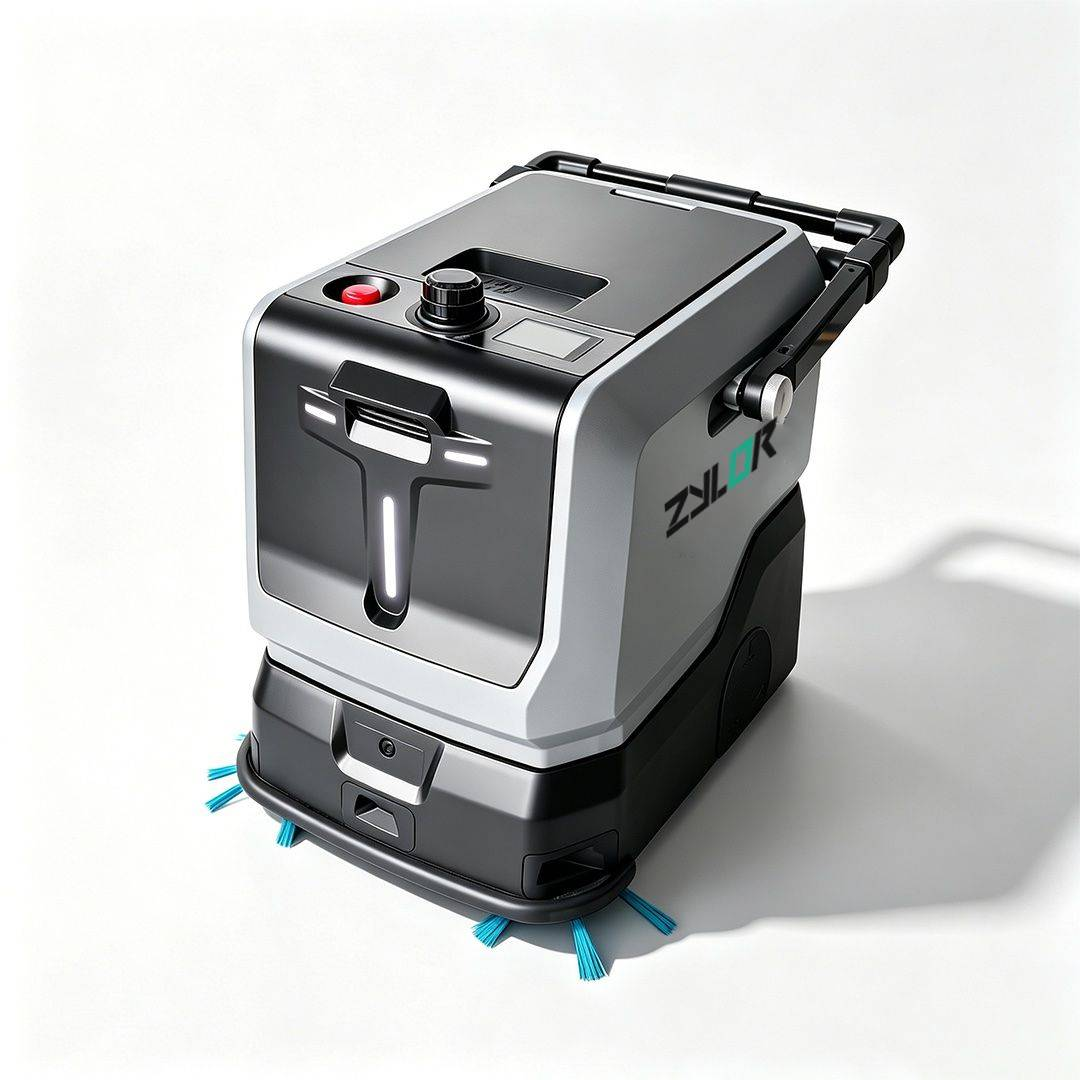
These priorities can overlap. A busy hotel can have demanding navigation requirements, while a clean warehouse zone may generate relatively little debris.
A category called “robot vacuum” may include machines that sweep, vacuum, mop, or scrub.
Identify the actual function needed:
Vacuuming or sweeping for suitable loose debris.
Wet scrubbing for compatible floors and removable adhered soil.
A supported combination of functions for mixed tasks.
Check whether multiple functions run together or as separate modes.
ZYLOR’s commercial cleaning robot range and industrial cleaning robot range provide starting points for comparing platforms. Review the individual model specification before shortlisting.
Document what the robot will encounter, including the amount, size, shape, and condition of the material.
Loose office dust, packaging fragments, metal particles, and damp waste present different challenges. Long film, straps, sharp objects, and fibrous materials may require removal before robotic cleaning.
Do not assume that an industrial label authorizes collection of all these materials.
Ask the supplier for:
Permitted and prohibited debris.
Pickup limits and collection-system design.
Procedures for wrapped or obstructed brushes.
Suitable emptying and cleaning methods.
Any application restrictions.
ZYLOR presents the S9 industrial sweeping robot for industrial dry-waste collection. Confirm suitability using examples from your own site.

A larger bin may reduce emptying frequency, but volume alone does not establish how long the robot can work.
Debris density, shape, loading behavior, and filter condition also matter. Ask whether the stated capacity is nominal and how the machine indicates that servicing is needed.
Do not assume automatic emptying is included. Confirm whether staff must remove, carry, or clean the collection container.
Assess filtration against the actual dust and the intended application.
Request documentation for the proposed filter and, where relevant, the complete collection system. A filter claim alone does not establish containment performance for the entire robot.
Hazardous or combustible dust requires an application-specific assessment. Do not treat a general floor-cleaning robot as approved for such material without suitable supporting evidence.
The same principle applies to commercial spaces with particular air-quality requirements. “Commercial” does not mean filtration is unimportant.
Confirm suitability for the actual carpet or hard floor, including transitions, joints, coatings, and damaged areas.
Also establish approved operating conditions for temperature, moisture, and indoor or outdoor use.
An IP rating, if documented, describes specified ingress protection. It does not by itself establish wet pickup, washdown suitability, chemical resistance, or outdoor operation.
Both commercial and industrial robots can use different combinations of mapping and detection technology.
A sensor list does not independently establish reliable route completion.
Evaluate conditions relevant to your facility:
Chairs, carts, pallets, and temporary obstacles.
Narrow passages and turning areas.
Glass, reflective surfaces, and variable lighting.
Low or projecting objects.
Restricted zones and access to the dock.
Industrial traffic needs coordinated site planning. Do not assume a robot can predict or safely negotiate every movement of a forklift simply because it has obstacle detection.
Arrange controlled demonstrations with the supplier and site team.
Measure the robot’s complete operating footprint, not only its body width.
Confirm access beneath permitted structures, around furniture, and beside racking. Record areas it cannot clean and the manual work that remains.
Neither category guarantees flush edge cleaning or access beneath storage racks. These outcomes depend on dimensions, brush reach, clearance, and the route.
Runtime should be compared in the required cleaning mode and representative conditions.
Include charging, debris emptying, filters, and any water servicing relevant to the machine. Automatic charging does not mean uninterrupted cleaning.
Battery chemistry, usable capacity, reserve settings, and charging rules are model-specific. Do not assume that all industrial machines use one chemistry or that all commercial machines use another.
For extended schedules, assess task timing and service availability before deciding whether one robot is sufficient.
Ask what is included for scheduling, remote status, alerts, task records, and multi-robot management.
Door, elevator, or building-system integration must be confirmed for the exact model and site. Industrial positioning does not automatically include an API, and commercial positioning does not rule one out.
Task maps can support operational monitoring. They do not independently prove sanitation or that the floor met a cleaning standard.
Match the proposed machine to each zone instead of assigning one category to an entire building.
Site requirement | Selection approach |
|---|---|
Carpeted office | Verify carpet pickup, transitions, noise, and furniture access |
Retail hard floors | Confirm whether loose-debris cleaning, wet cleaning, or both are required |
Warehouse with packaging debris | Verify permitted waste, collection performance, and emptying workflow |
Factory with specialized dust | Assess material-specific suitability before routine deployment |
Mixed office and production site | Evaluate each zone and consider separate equipment where appropriate |
Avoid both underspecification and unnecessary complexity. A machine should solve the documented task rather than satisfy a label preference.
Trial measure | Evidence to collect |
|---|---|
Cleaning result | Remaining debris and areas requiring rework |
Collection performance | Pickup, dust release, and servicing needs |
Access | Missed areas and difficult transitions |
Route completion | Accepted area within the available time |
Human involvement | Assistance frequency, cause, and duration |
Routine care | Emptying, cleaning, charging, and consumable work |
Staff usability | Ability to start, monitor, and recover tasks |
Run the trial under representative conditions and use the same acceptance criteria when comparing proposals.
Compare the robot, dock, accessories, software charges where applicable, commissioning, training, consumables, and site preparation.
Clarify parts availability, warranty scope, repair arrangements, and support coverage in your region. Neither category guarantees local technicians, a particular response time, or a fixed equipment lifespan.
Before deployment, agree on daily responsibilities and train the staff who will operate and maintain the system. Review network access, data handling, and remote-support permissions with your IT team where applicable.
Possibly, if the exact model is approved for the floor, debris, environment, and workload. A warehouse office and a production aisle may need different solutions. Confirm suitability rather than making a category-wide assumption.
Only rely on capabilities confirmed for the specific machine and material. Sharp particles, long fragments, and wrapping materials can need separate handling.
No. Industrial product ranges can include compact machines, while commercial ranges can include platforms for large facilities. Compare actual dimensions, capacity, and access requirements.
Not necessarily. Maintenance depends on the design and workload. Check brushes, filters, collection containers, charging components, and other service items in the operating instructions.
The better value is the model that meets the agreed cleaning standard and schedule at an acceptable total cost. Use trial results, staff time, service requirements, and contract terms to compare.
Comparing robotic cleaning options for commercial or industrial areas?
Contact ZYLOR with your floor types, typical debris, cleanable area, operating schedule, and access restrictions. Discuss suitable models and the site checks needed to evaluate pickup, navigation, and daily servicing.

