
Views: 0 Author: Site Editor Publish Time: 2026-11-04 Origin: Site


An industrial cleaning robot is a machine that combines cleaning equipment with navigation and control systems to perform assigned tasks with reduced direct driving by an operator.
In warehouses and factories, these robots commonly perform floor sweeping, vacuum collection, or wet scrubbing. Their capabilities depend on the model, cleaning mechanism, operating environment, and configuration.
An autonomous floor-cleaning robot follows a practical cycle: sense the surroundings, establish its position, plan movement, clean the assigned area, and respond to obstacles or service needs.
This guide explains that cycle and the human responsibilities that remain.
Table of Contents
A conventional cleaning machine supplies the brushes, collection system, or washing equipment. An autonomous platform adds systems that control movement and task execution.
The main components typically include:
Component | Role |
|---|---|
Cleaning system | Sweeps, vacuums, or washes the floor |
Drive system | Moves and steers the machine |
Sensors | Provide information about the surroundings and machine state |
Navigation software | Estimates position and plans movement |
Task controls | Manage assigned areas, settings, and schedules |
Battery and charging system | Supply power and support return to service |
The exact components vary. Not every robot includes the same sensors, reporting functions, or automated servicing equipment.
ZYLOR’s industrial cleaning robot range includes platforms positioned for sweeping, scrubbing, and compact industrial cleaning.
Industrial sites can introduce demanding combinations of debris, floor texture, traffic, and working hours.
However, “industrial” does not establish a universal chassis material, battery runtime, tank size, or brush pressure. Those specifications must be checked for the proposed model.
It also does not mean the robot is suitable for every production residue or hazardous environment.
Autonomy describes supported operation without continuous manual driving. It does not remove routine inspections, consumable replacement, or staff responsibility.
Some robots automate charging. Others may also support water servicing or additional functions. Confirm these separately rather than treating them as one package.
Sensors provide information used for navigation, obstacle detection, and machine control.
Depending on the design, these may include LiDAR, cameras, depth sensors, wheel encoders, inertial sensors, proximity sensors, or contact devices.
Different sensors provide different information. A navigation sensor does not automatically detect every obstacle, and a contact device does not replace detection before contact.
The complete system must be evaluated under the site’s lighting, floor, and access conditions.
The robot needs to know where it is relative to its assigned working area.
SLAM stands for Simultaneous Localization and Mapping. It describes methods that build a map while estimating position within it.
SLAM is not limited to LiDAR. Visual SLAM uses camera information, while other approaches use laser measurements or multiple sensor sources.
Mapping and routine operation can also be separate stages. A robot may create or receive a map during setup, then use that map to estimate its position during later tasks.
The commissioning process should establish permitted areas, restricted zones, and practical routes.
The task system identifies where cleaning is required. Coverage planning organizes the cleaning passes, while motion planning determines how the robot moves between positions.
Some systems use taught routes. Others calculate coverage within assigned zones. These approaches can be combined.
A taught route does not automatically mean the robot lacks obstacle detection. Likewise, autonomous route planning does not guarantee that every changing layout can be handled without assistance.
The useful question is whether the proposed system completes the assigned work reliably at your site.
Movement and cleaning equipment operate together, but the cleaning process depends on the machine type.
Cleaning function | Typical process |
|---|---|
Sweeping | Brushes move permitted debris into a collection path or container |
Vacuum collection | Airflow draws suitable loose material into a collection system |
Wet scrubbing | Liquid and brushes or pads loosen soil; a recovery system collects dirty water |
Multifunction cleaning | Supported mechanisms operate together or in separate modes |
For dry-waste collection, ZYLOR presents the S9 industrial sweeping robot.
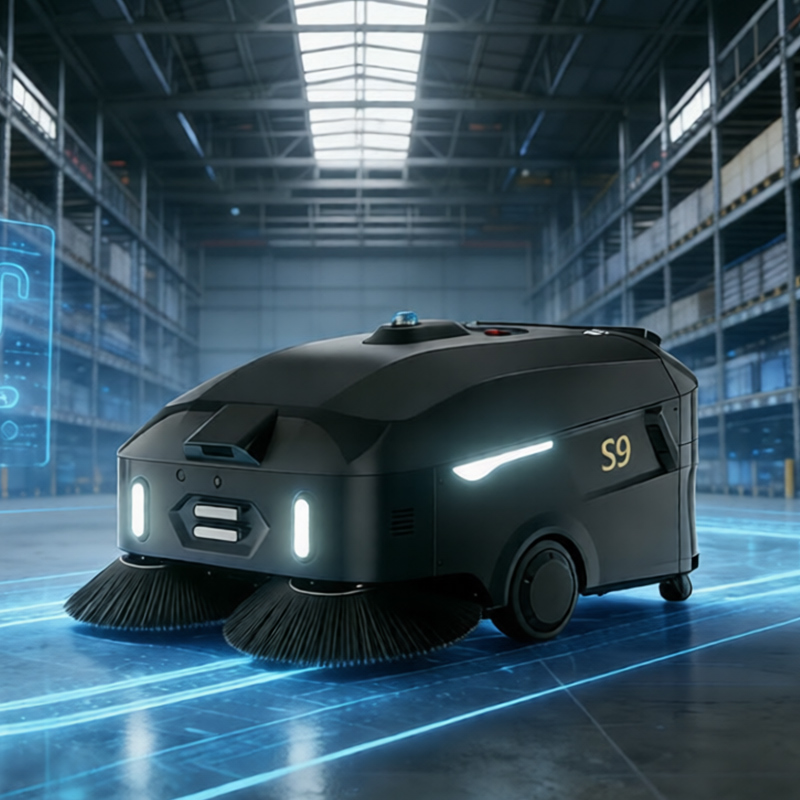
For wet-cleaning applications, the S95 industrial floor scrubber robot provides another platform to review.
Confirm permitted debris, floor compatibility, and settings before use. Routine floor washing should not be treated as a response to an unknown chemical spill.
A working route may become blocked by a pallet, cart, or other object.
Depending on the system and settings, the robot may slow down, stop, wait, reroute, skip an area, or request help.
No single response is appropriate in every situation. A narrow blocked aisle may have no usable alternative route.
Demonstrate the expected behavior during a controlled site evaluation. Coordinate operation with the facility’s traffic arrangements rather than relying on obstacle detection alone.
A task may end when the assigned work is completed or when the robot needs charging, emptying, water servicing, or assistance.
Supported automatic docking can help return the robot to a service location. Task resumption and water handling remain model-specific functions.
Reports may show recorded activity, interruptions, and missed areas. They support supervision but do not independently prove that the floor met a cleaning or disinfection standard.
Suitable tasks can include collecting approved loose debris, washing compatible hard floors, and maintaining assigned corridors or open areas.
Applications may include storage aisles, production routes, packing areas, and logistics spaces.
The assignment should reflect the actual soil and floor condition. A robot that handles ordinary dirt may not be suitable for sharp waste, wrapping materials, or specialized dust.
Where included, scheduling allows teams to assign cleaning times and zones. Monitoring can help staff identify incomplete work or service needs.
Door, elevator, or building-system integration may extend the working area, but these capabilities require confirmation for the exact model and site.
They should not be assumed from the term “autonomous.”
Manual or specialist work may remain necessary for:
Stairs and inaccessible spaces.
Detailed cleaning around equipment.
Unexpected or unsuitable spills.
Restricted production zones.
Equipment preparation, inspection, and maintenance.
Cleaning the floor also does not automatically clean machinery, high-touch surfaces, or elevated structures.
Navigation cannot compensate for unsuitable brushes, chemicals, or debris handling.
Check flooring guidance and evaluate the proposed cleaning result. For scrubbers, inspect residual moisture and streaks rather than assuming the floor will be immediately dry.
Measure passages, turns, transitions, approved ramps, and access to the dock.
Test relevant conditions such as reflective surfaces, variable lighting, and changing storage positions. Do not assume one sensor technology is always superior.
Compare battery operation with collection capacity and, where applicable, water needs.
A robot may need servicing before its battery is depleted. Automatic charging and automatic refilling are separate functions, and their installation requirements differ.
Follow the approved operating, charging, and maintenance instructions for the specific configuration.
Assign responsibility for starting tasks, checking results, responding to alerts, and completing routine care.
During a pilot, record cleaning quality, accepted area, elapsed time, assistance, and servicing. These measures show how the complete system works rather than how impressive an isolated feature appears.
No. Navigation methods vary. Some use SLAM during mapping, while others use different positioning methods or a combination of techniques. Ask how the proposed model is commissioned and navigates during normal operation.
No. Visual SLAM estimates position and builds a map using visual information. Obstacle detection is a separate function, although systems may share sensors or data.
Only rely on operation within the model’s approved lighting conditions. A LiDAR sensor does not establish that every detection and cleaning-related function works in complete darkness.
The floor-cleaning platforms discussed here should not be assumed to climb stairs. Ramps, thresholds, and multi-floor arrangements must be checked against the exact model and site.
It depends on the tasks, layout, configuration, and servicing needs. Measure routine care and exception handling during a representative trial rather than relying on a general autonomy claim.
Exploring industrial cleaning automation?
Contact ZYLOR with your floor types, typical debris, assigned cleaning areas, and operating schedule. Discuss how a proposed robot would navigate, clean, return for service, and fit into your daily maintenance process.

