
Views: 0 Author: Site Editor Publish Time: 2026-09-15 Origin: Site


Facility managers face immense pressure to offset staffing shortages with autonomous cleaning technologies. Deploying the wrong robotic form factor creates severe operational bottlenecks. Running a dry machine in an environment demanding deep sanitation fails health compliance. Pushing a wet machine over mixed flooring damages assets and requires heavy manual rework. Small and medium businesses often fall into the prosumer trap, deploying high-end residential vacuum and mop combos in commercial spaces. This approach voids warranties and fails to meet capacity demands. Choosing between a commercial robot vacuum vs floor scrubber requires strict evaluation of floor composition, soil types, and infrastructure readiness. This guide breaks down the mechanical differences between these machines so you can match the right autonomous equipment to your exact facility requirements.
Primary Function: Robot vacuums are engineered for dry debris extraction and dust control on mixed surfaces (carpet and hard floors), whereas robotic floor scrubbers are designed for wet, deep-cleaning, and sanitizing strictly on hard, non-porous surfaces.
The Three Main Classes: Buyers must distinguish between commercial vacuums (suction-based, mixed floors), robotic floor scrubbers (wet application/extraction, hard floors), and industrial sweepers (dry bulk debris collection without suction).
Infrastructure Demands: A floor scrubber requires significantly more facility infrastructure, including accessible water supply, drainage for recovery tanks, and dedicated maintenance zones, compared to the standard electrical docking of robot vacuums.
Maintenance Realities: Autonomous does not mean zero-maintenance; staff must be allocated for daily tasks such as emptying dustbins (vacuums) or cleaning squeegees, flushing tanks, and replacing pads (scrubbers).
ROI Timeline: Justifying the higher capital expenditure of a robotic floor scrubber relies on offsetting heavy manual labor hours in large-scale environments (warehouses, airports), while robot vacuums offer faster deployment in smaller or carpet-heavy commercial spaces (hotels, offices).
Table of Contents
Autonomous cleaning success relies on matching the machine's mechanical action to the specific soil profile of your facility. You must remove the dirt without damaging the substrate. Selecting the wrong category of machine guarantees operational failure. We must first clarify the distinct categories of automated cleaning equipment before looking at specific deployment strategies.
Many facility managers confuse industrial dry sweepers with vacuums. Sweepers collect heavy bulk debris. They handle wood chips, pallet splinters, large gravel, and heavy manufacturing byproducts. They use rotating cylindrical main brooms to physically throw debris into a collection hopper. Sweepers operate entirely without the suction of a vacuum. They also lack the wet-cleaning capabilities of a scrubber. You deploy sweepers strictly for heavy industrial dry environments like lumber mills, outdoor parking structures, or heavy manufacturing plants where fine dust control is secondary to bulk debris removal.
Commercial robot vacuums rely on high-performance suction motors measured in cubic feet per minute (CFM) and water lift. They utilize rotating agitator brushes to physically beat the carpet fibers or sweep the hard floor surface, lifting dirt into the vacuum channel. High-efficiency particulate air (HEPA) filtration systems, often rated at H13 or H14, trap microscopic dust particles, preventing them from exhausting back into the facility air. These machines excel at daily dry maintenance. They collect dry particulate matter, fine dust, human and animal hair, and light paper debris.
Surface versatility stands out as their primary mechanical advantage. A commercial robot vacuum transitions seamlessly between different environments. It moves from dense commercial broadloom carpeting to entryway walk-off mats. It then navigates onto hard flooring like polished concrete or luxury vinyl tile (LVT) without missing a beat. The machine adjusts its brush deck height and suction power automatically based on the surface resistance it detects. This makes them ideal for environments with highly mixed floor plans, such as corporate office buildings, hotels, and retail showrooms.
A robotic Floor Scrubber operates through a complex, multi-stage mechanical sequence. First, it dispenses a precise solution of water and chemical detergent directly onto the floor. Next, it applies heavy mechanical agitation. It uses either spinning disc pads or cylindrical brushes, applying anywhere from 50 to 150 pounds of downforce to scrub the floor. Finally, it performs immediate extraction. A rear vacuum squeegee, typically made of Linatex, polyurethane, or gum rubber, pulls the dirty water slurry into an onboard recovery tank.
These machines handle severe messes and biological hazards. Their primary use case involves removing adhered soils. They tackle forklift tire marks, grease, sticky spills, and heavy industrial grime. They also provide deep sanitization for high-traffic areas like hospital corridors and grocery store aisles. A true commercial scrubber leaves floors immediately dry and safe for foot traffic. This rapid drying function mitigates slip-and-fall hazards entirely, which is a massive liability concern in public-facing facilities.
However, scrubbers have strict surface limitations. You can only use them on water-resistant substrates. They are limited to sealed concrete, vinyl composition tile (VCT), ceramic tile, terrazzo, and epoxy coatings. Running a scrubber over unsealed wood, laminate, or carpet causes catastrophic water damage, delamination, and mold growth.
You cannot select autonomous equipment based on aesthetics or basic square footage alone. You must evaluate your facility systematically. This requires profiling your soil, measuring your layout, assessing your aisle widths, and understanding your dynamic obstacles.

Understanding your daily debris dictates your hardware choice. Different machines handle different messes. A machine designed for fine dust will choke on a wet spill. Review the decision matrix below to align soil types with the correct technology.
Soil Type | Recommended Technology | Technical Reasoning |
|---|---|---|
Fine dust, hair, paper scraps | Commercial Robot Vacuum | Suction and HEPA filters capture dry particulates effectively without smearing. |
Sticky spills, grease, mud | Robotic Floor Scrubber | Requires wet chemical application and mechanical agitation to break adhesion. |
Wood chips, metal shavings, gravel | Industrial Sweeper | Bulk debris damages vacuum motors and clogs squeegees. Requires hopper collection. |
Mixed light debris and light spills | Cylindrical Sweep-Scrubber | Cylindrical brushes sweep light solids into a tray while simultaneously scrubbing the floor. |
Standard disc floor scrubbers require strict pre-sweeping protocols. If you run a disc scrubber over loose debris like pallet wrap, zip ties, or heavy gravel, it smears the dirt. The debris then clogs the rear squeegee assembly. A clogged squeegee breaks the vacuum seal against the floor, leaving dangerous trails of dirty water behind. Your staff must manually sweep or dust-mop the area before deploying a disc scrubber. Cylindrical sweep-scrub models bypass this step. They feature a debris catch tray behind the cylindrical brushes. They handle light debris and wet scrubbing simultaneously, eliminating the pre-sweep labor requirement.
Scalability matters when selecting autonomous equipment. You must compare battery capacities, solution tank volumes, and cleaning path widths. Cleaning widths dictate how fast a machine covers an area, often measured in square feet per hour. Large-scale environments demand heavy-duty specifications. A 100,000 square foot logistics center needs a massive scrubber. It requires high-capacity lithium-ion batteries and 30-gallon solution tanks to minimize dump-and-fill cycles. A compact 3,000 square foot coffee roastery needs a nimble machine. It requires a smaller footprint to navigate tight tables, narrow hallways, and point-of-sale displays.
Form-factor mismatches ruin deployments. Do not deploy a bulky warehouse cleaning robot in a hotel lobby. It will get stuck constantly between luggage carts and furniture. It will intimidate guests with its size and operating noise. Conversely, do not deploy a compact vacuum in an expansive logistics center. It will take days to clean a single zone. It will require constant manual emptying of its small dustbin, defeating the purpose of automation.
Pay close attention to transition zones and thresholds. Deploying wet scrubbers near unsealed flooring carries high risk. Water damage occurs easily if a scrubber crosses onto carpet or unsealed expansion joints. Ensure your mapping software allows for strict virtual boundaries and no-go zones around vulnerable substrates.
Modern cleaning robots use LiDAR, 3D cameras, ultrasonic sensors, and AI to navigate safely around people and equipment. Robot vacuums need fast obstacle avoidance in busy retail spaces, while industrial scrubbers must detect forklifts, pallets, and machinery in warehouses. Advanced sensors and navigation algorithms help ensure safe and reliable operation in these complex environments.
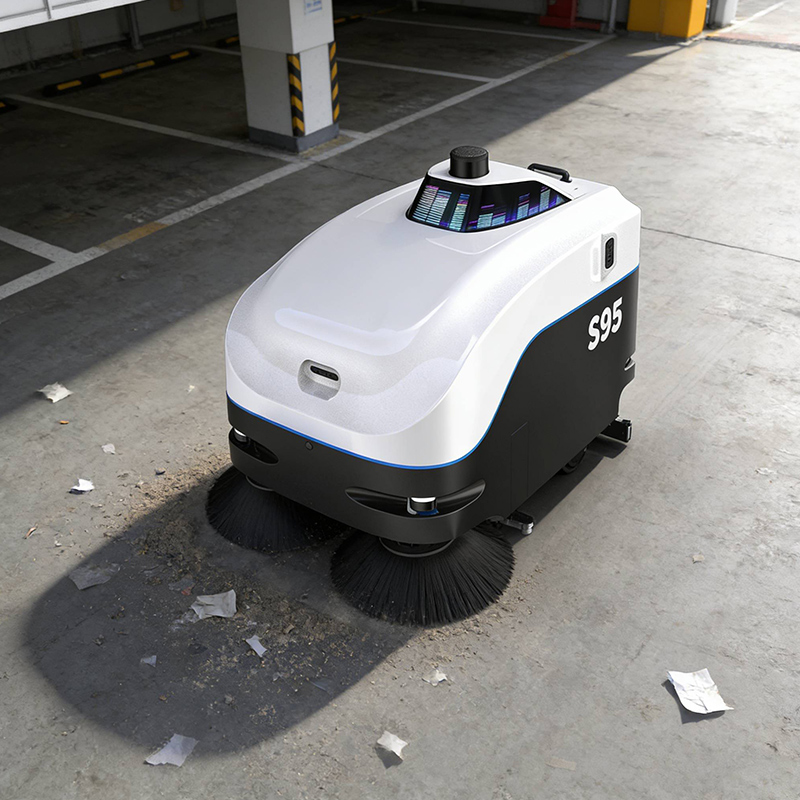
To fully understand the operational impact of these machines, you must examine their underlying hardware. The mechanical components dictate how long the machine runs, how aggressively it cleans, and how well it recovers debris or water.
Battery technology dictates the operational ceiling of any autonomous cleaner. Older or budget-focused machines often rely on Absorbed Glass Mat (AGM) lead-acid batteries. AGM batteries are heavy, require long charging cycles, and degrade quickly if opportunity-charged. Modern commercial robots utilize Lithium-Iron Phosphate (LiFePO4) or standard Lithium-ion battery packs. These advanced batteries allow for rapid charging and opportunity charging. A robot can clean for three hours, dock for forty-five minutes during a shift change, and deploy again with a significant charge. This continuous availability is critical for facilities operating on 24/7 schedules.
The cleaning efficacy of a scrubber relies heavily on brush pressure and downforce. A manual mop applies perhaps five to ten pounds of pressure. An autonomous floor scrubber applies mechanical downforce via electric actuators, pushing the scrub deck into the floor with 50 to 150 pounds of pressure. This aggressive mechanical action, combined with the correct pad grit or brush bristle stiffness, shears adhered soils off the concrete. Vacuums, conversely, do not rely on heavy downforce. They rely on the rapid rotation of the agitator brush to separate carpet fibers and the high-velocity airflow to lift the particulates.
Water recovery systems separate a high-quality scrubber from a liability hazard. The vacuum shoe must maintain a perfect seal with the floor. The squeegee blades must flex exactly the right amount to channel water to the center suction hose. Polyurethane blades offer excellent tear resistance on rough concrete, while Linatex blades provide superior water control on smooth, uneven surfaces like grouted tile. If the vacuum motor lacks sufficient water lift, or if the squeegee design is flawed, the machine will leave a dangerous, slippery film of water in its wake.
Deploying robots requires physical facility modifications and significant adjustments to your daily operational workflows. Facility managers who treat autonomous equipment like standard manual tools often face low utilization rates and frustrated staff.
Deployment requirements vary by robot type. Robot vacuums typically need only a charging outlet, while autonomous scrubbers may require water supply, drainage, and auto-fill or auto-dump stations. Proper mapping is also essential, including setting routes, no-go zones, and safety boundaries. Major facility layout changes may require the robot to be re-mapped.
Autonomous cleaning robots still require daily maintenance to operate reliably. Staff should clean sensors, remove debris from brushes, empty dustbins, and rinse recovery tanks to prevent navigation issues, bacteria, and odors. Assigning a dedicated operator to handle routine maintenance, monitor performance, and resolve errors helps keep the robots efficient and ready for daily operation.
The choice between a robot vacuum and a floor scrubber is a strict technical requirement dictated by floor type, soil condition, and facility scale. Commercial robot vacuums excel in hospitality, corporate offices, and retail spaces where mixed flooring and dry debris are the primary concerns. Robotic floor scrubbers dominate logistics centers, grocery stores, and manufacturing plants where deep sanitation and wet extraction on hard floors are mandatory.
Take the following actionable steps to ensure a successful deployment:
Conduct a comprehensive site audit to map your specific floor types, measure aisle widths, and identify daily soil conditions.
Request a proof-of-concept demonstration in your actual facility during peak operational hours to test navigation capabilities.
Assess your facility's plumbing infrastructure to confirm readiness for auto-fill and auto-dump docking stations.
Assign a dedicated staff member to manage daily robot maintenance, monitor deployment schedules, and clean sensor arrays.
A: No. They serve entirely different functions. A vacuum uses suction to remove dry dust and loose debris from carpets and hard floors. It cannot remove adhered grime, sticky spills, or grease. A scrubber uses water, chemicals, and mechanical agitation to deep-clean and sanitize hard surfaces.
A: It is highly discouraged. Prosumer models are built for light residential use. Deploying them in commercial spaces typically voids the manufacturer warranty. They have insufficient tank and dustbin capacities for large areas. They also lack the heavy-duty extraction power needed for commercial foot traffic.
A: Robotic sweepers dry-collect heavy bulk debris like wood chips and gravel. They use rotating brooms to throw debris into a hopper without using suction. Robot vacuums use powerful suction motors and HEPA filtration to lift fine dirt, hair, and dust from mixed surfaces.
A: It depends on the brush deck. Disc scrubbers only scrub and require the floor to be pre-swept. If not pre-swept, debris clogs the squeegee. Cylindrical scrubbers feature brushes that sweep light debris into a catch tray while simultaneously scrubbing the floor.
A: Daily maintenance is mandatory. Staff must drain and thoroughly rinse the dirty water recovery tank to prevent bacterial odors. They must wipe down all navigation sensors and cameras. Finally, they must clean the squeegee blades to maintain proper vacuum suction and prevent water trails.
A: They use advanced sensor arrays. LiDAR scanners map the environment in real-time. 3D depth cameras identify the size and shape of temporary obstacles like displays or people. Drop sensors detect edges to prevent the robot from falling down stairs or loading docks.

