
Views: 0 Author: Site Editor Publish Time: 2026-09-15 Origin: Site


Facility management operations are shifting from manual floor care to autonomous cleaning systems. Managers deal with high janitorial turnover, inconsistent cleaning quality, and strict requirements for documented hygiene standards. Relying entirely on manual labor for large-scale floor maintenance creates operational bottlenecks and uneven results. Understanding the technical mechanics of a commercial floor cleaning robot—specifically how it navigates dynamic environments and physically cleans—is a prerequisite for evaluating its viability and successfully integrating it into your existing operations. Modern autonomous machines operate as heavy-duty industrial tools built for rigorous daily schedules. By grasping the underlying technology, facility leaders can make informed decisions about deployment, workflow integration, and long-term fleet management without disrupting current operations.
Navigation is driven by Sensor Fusion: Modern units do not rely on basic bump-and-turn mechanics; they utilize a combination of 3D LiDAR, depth cameras, and ultrasonic sensors to map facilities and dynamically avoid obstacles.
Cleaning efficacy matches industrial standards: Autonomous scrubbers utilize the same mechanical principles as manual ride-on machines, including precise chemical dispensing, consistent brush down-pressure, and high-suction water recovery.
Autonomy requires structured implementation: Successful deployment relies on initial facility mapping, establishing clear operational workflows, and training staff to work alongside the machines (cobotics).
Value extends beyond labor replacement: The primary ROI driver is the redeployment of human workers to high-value, detail-oriented tasks, while the robot handles repetitive, large-scale floor coverage at a fraction of the cost per shift.
Table of Contents
Buyers need assurance that autonomous machines match the deep-cleaning capabilities of traditional ride-on or walk-behind scrubbers. The physical cleaning mechanism of an autonomous unit mirrors its manual counterpart. The control system driving the hardware is the only difference.
Understanding the specific application of each machine type dictates facility planning. We categorize these machines based on their primary function and the floor types they maintain.
Machine Type | Primary Surface | Core Function |
|---|---|---|
Autonomous Vacuum | Commercial Carpet | Utilizes rotating beater bars and high-efficiency particulate air filtration to extract embedded dirt. |
Autonomous Sweeper | Hard Industrial Floors | Manages dry debris, dust, and loose particulate matter without the use of water or chemicals. |
Autonomous Scrubber | Hard Surfaces (Concrete, Tile, Epoxy) | Manages liquid dispensing, active mechanical scrubbing, and immediate water recovery. |
Loose debris must be managed before water touches the floor. Failing to remove debris causes streaking and damages the vacuum system. Advanced scrubbers incorporate pre-sweep mechanisms. Small cylindrical brushes sit ahead of the main scrubbing deck. They capture loose dirt, dust, and small particulate matter, depositing it into a dedicated hopper.
Robotic sweeping has strict physical limits. The intake clearance determines the maximum debris size the machine handles. Large items like pallet shards, stretch wrap, or heavy metal shavings will jam the sweeping mechanism. They can also tear the squeegee blade. Manual pre-dusting remains necessary in heavy industrial environments where large debris accumulates.
The scrubbing phase uses a highly controlled fluid delivery system. Solution tanks meter water and detergent based on the machine's real-time speed. If the machine slows down to navigate a tight corner, the fluid output decreases proportionally. This prevents water pooling on the floor.
Brush mechanics determine the friction applied to the floor. Facilities choose between two primary configurations based on their surface types:
Disc Brushes: Flat, circular brushes that rotate horizontally. They provide excellent surface contact and are ideal for smooth floors requiring high friction to remove scuff marks. Operators can swap out different pad types, such as red pads for daily surface cleaning or white pads for high-gloss polishing.
Cylindrical Brushes: Tube-shaped brushes that rotate vertically. They operate at higher speeds and can simultaneously sweep small debris into a catch tray while scrubbing. This makes them highly versatile for grouted tile, uneven concrete, or warehouse floors with heavy dust accumulation.
A high-quality commercial floor cleaning robot maintains consistent down-pressure on these brushes using active actuators. The machine applies the exact same pressure whether the battery is fully charged or nearing depletion.
Leaving a floor wet creates an immediate occupational safety hazard. The water recovery system relies on a parabolic squeegee paired with a high-powered vacuum motor. The material of the squeegee blade impacts performance directly. Linatex blades offer high flexibility, making them ideal for uneven surfaces or grouted tile where they need to conform to the floor profile. Urethane blades are stiffer and highly resistant to chemicals and oils, making them the standard choice for automotive shops or industrial manufacturing floors.
As the machine moves forward, the rear-mounted squeegee funnels dirty water to a central suction point. The vacuum motor creates negative pressure, lifting the slurry into a recovery tank. Onboard sensors monitor this water recovery process continuously. If the system detects a drop in suction or a blockage in the squeegee hose, the machine halts fluid dispensing. It alerts the operator immediately, ensuring floors remain dry.
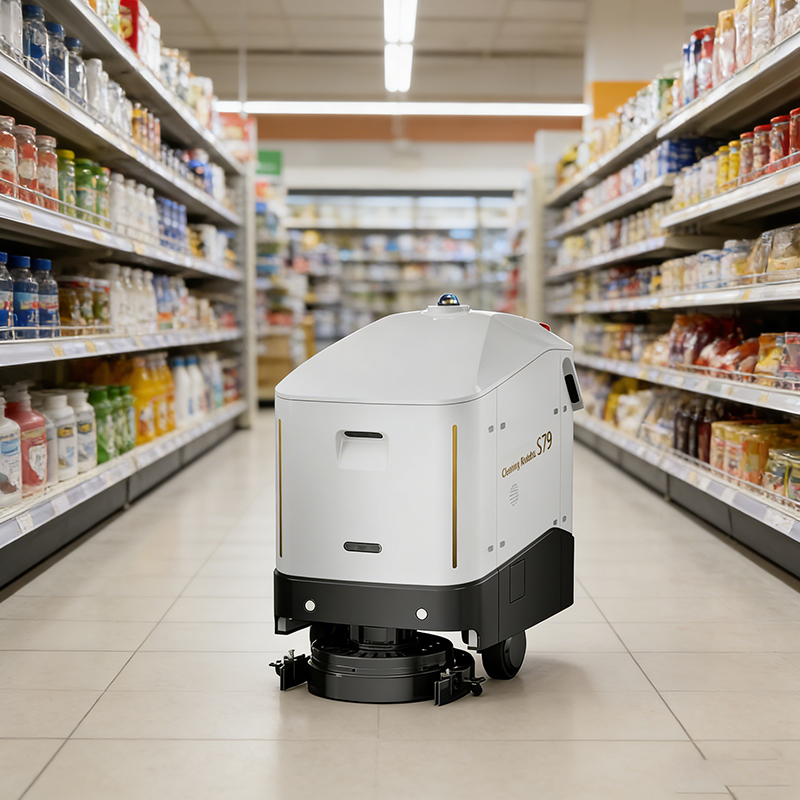
Older automated guided vehicles relied on wire-guided or tape-guided systems. They required physical infrastructure modifications to operate. Modern autonomous navigation abandons rigid tracks for dynamic, software-driven spatial intelligence.
SLAM acts as the computational backbone of autonomous navigation. When a machine enters a facility, it uses its sensors to build a digital map of the environment. It tracks its own exact location within that newly created map at the same time.
Warehouses and retail stores are never static. Pallets move, temporary displays go up, and furniture shifts. The software updates its internal map continuously. It recognizes temporary obstacles, like a forklift driving past or a pallet dropped in an aisle, while maintaining its understanding of permanent structural boundaries like walls and support columns.
No single sensor perceives a complex environment perfectly. Sensor fusion combines data from multiple hardware sources to create a real-time 3D model of the machine's surroundings.
Sensor Type | Primary Function | Operational Advantage |
|---|---|---|
3D LiDAR | Long-range mapping and boundary detection | Fires laser pulses to measure exact distances, creating a precise geometric map of the facility regardless of lighting conditions. |
RGB-D (Depth) Cameras | Object identification and shape recognition | Differentiates between a human stepping into the path and a static cardboard box, allowing for nuanced avoidance behavior. |
Ultrasonic Sensors | Proximity detection for transparent surfaces | Uses sound waves to detect glass doors or highly reflective surfaces that might confuse optical sensors. |
Drop Sensors | Elevation monitoring | Looks downward to detect sudden changes in floor height, preventing falls down stairwells or off loading docks. |
The onboard software calculates the most efficient cleaning path once the environment is mapped. Early robotics relied on randomized patterned movements. Today's systems utilize highly precise, mapped routes designed to maximize coverage and battery life.
A common strategy involves cleaning the perimeter of a designated zone first. This establishes boundaries. The machine then executes overlapping internal lines. The software calculates the exact overlap required to ensure zero missed spots. This minimizes redundant passes and extends the operational runtime per charge.
Assessing the daily operational burden on existing facility staff determines deployment success. Automation should streamline workflows, not create new bottlenecks requiring constant human intervention.
Implementing an autonomous scrubber follows a strict operational sequence to ensure safety and efficiency:
Site Assessment: Facility managers walk the floor to identify permanent obstacles, drop-offs, and high-traffic zones.
Base Station Installation: Technicians install the docking station near a water source and floor drain for automated fluid management.
Route Mapping: An operator manually drives the machine along the optimal cleaning path, allowing the SLAM system to record the route.
Parameter Configuration: Managers set the specific water flow rate, brush pressure, and travel speed for that specific route.
Autonomous Testing: The machine runs the route autonomously under human supervision to verify obstacle avoidance and water recovery performance.
Fleet management software allows facility managers to refine these maps. Operators draw virtual boundaries and establish strict no-go zones. They block off areas around delicate machinery or high-traffic pedestrian corridors.
Facility managers program scheduled runs during low-traffic hours to maximize efficiency. "Lights-out" scheduling allows the machine to operate overnight or during off-shift hours. The robot cleans while the facility is empty, eliminating disruption to daily business operations.
Initiating a route is straightforward. Staff stage the machine at its starting point. They select the pre-programmed route via an onboard touchscreen or a paired mobile app, and press start. The machine takes over and executes the exact parameters saved during the teaching phase.
The machine autonomously navigates back to its base station when a cleaning route is complete or the battery runs low. Standard docking stations handle battery recharging. Advanced docking stations manage fluids as well.
These advanced stations connect to the machine automatically. They drain the dirty water from the recovery tank and flush the system to prevent odor buildup. They then refill the clean water and chemical tanks. This automation reduces the daily touch-time required by human staff.
Not every building is suited for automated floor care. Establishing a framework for determining if a specific facility is a viable candidate ensures a successful deployment.
Square footage acts as the primary determining factor. A facility generally needs a minimum of 10,000 square feet of cleanable hard floor to justify an autonomous scrubber. Smaller spaces feature too many tight corners and obstacles, negating the efficiency gains of automation.
Surface type dictates compatibility. Autonomous scrubbers excel on polished concrete, vinyl composition tile (VCT), epoxy coatings, and smooth ceramic tile. Highly irregular surfaces, deep grout lines, or floors with significant slopes require specialized brush configurations or manual intervention.
Addressing the human replacement myth maintains staff morale. Effective deployments position the commercial floor cleaning robot as a tool that amplifies the existing workforce. This concept is known as cobotics.
Calculating cost efficiency involves comparing the daily operational output of the machine against manual labor. A robot achieves up to three times the floor coverage of a human worker pushing a manual scrubber. The return on investment is realized through labor reallocation. The machine handles the repetitive task of large-scale floor scrubbing. Human staff shift to tasks requiring dexterity and judgment, such as restroom sanitation, high-dusting, and touchpoint disinfection.
Modern autonomous machines generate vast amounts of operational data. Fleet management dashboards provide facility managers with real-time visibility into machine performance.
These dashboards generate heat maps and coverage reports. They detail exactly which areas were cleaned, how much water was used, and how long the operation took. Incident logs record any obstacles encountered or areas bypassed. This data serves as tangible proof of clean. Managers use it to verify compliance to stakeholders, health inspectors, or facility owners.

Addressing the friction points of adopting autonomous technology ensures realistic expectations. Preparation mitigates operational risks.
Autonomous machines require network connectivity to receive software updates, sync map data, and upload reporting metrics to cloud dashboards. Facilities decide between utilizing existing Wi-Fi networks or relying on Cellular LTE connections.
Integrating with enterprise Wi-Fi requires coordination with IT departments to establish secure VLANs. Data privacy and enterprise IT security protocols demand strict review. IT teams verify how onboard cameras process data. They ensure video feeds are used strictly for local navigation and are not stored or transmitted in violation of corporate privacy policies.
Autonomy does not mean zero maintenance. Daily upkeep keeps the machine functioning optimally. Staff empty recovery tanks, wipe down optical sensors, and rinse squeegee blades to prevent streaking.
Maintenance Interval | Required Task | Operational Impact |
|---|---|---|
Daily | Empty and rinse recovery tank | Prevents sludge buildup and foul odors in the facility. |
Daily | Wipe down LiDAR and camera sensors | Ensures accurate navigation and prevents false obstacle detection. |
Weekly | Inspect and rotate squeegee blades | Maintains optimal vacuum suction and prevents water streaks. |
Monthly | Check brush wear and replace if necessary | Guarantees consistent floor contact and scrubbing friction. |
Long-term maintenance involves tracking consumable wear. Brush replacement cycles, squeegee rotation, and battery degradation factor into operational planning. Facilities account for ongoing software subscription fees that provide access to fleet management dashboards and continuous navigation updates.
Environmental conditions can affect robot navigation. Narrow aisles, steep ramps, heavy forklift traffic, direct sunlight, and uniform corridors may limit turning, traction, sensor accuracy, or SLAM mapping. Identifying these challenges during the initial site audit helps managers optimize cleaning routes and schedules for safer, more reliable operation.
Conduct a thorough audit of your facility's cleanable square footage and identify any major environmental edge cases.
Map out your current janitorial workflows to determine exactly where human labor can be reallocated once floor scrubbing is automated.
Schedule a live, in-facility demonstration with a vendor to test mapping capabilities, route optimization, and water recovery on your specific floor types.
Engage your IT department early to review network security requirements and data privacy protocols.
A: Runtime varies based on battery capacity, floor type, and brush pressure settings. Most industrial units operate between 3 to 6 hours on a single charge. Lithium-ion batteries provide longer runtimes and faster charging compared to traditional lead-acid options. This allows for multiple cleaning shifts per day when paired with opportunity charging stations.
A: No. These machines are designed for cobotics, meaning they work alongside human staff. While they automate the repetitive task of scrubbing large floor areas, human workers are still required for daily machine maintenance. Staff must also pre-sweep large debris and perform detail-oriented tasks like restroom cleaning, trash removal, and surface disinfection.
A: Autonomous cleaners are equipped with downward-facing drop sensors. These sensors instantly detect stairs, loading docks, or sudden elevation changes, prompting the machine to stop and reverse. While they cannot navigate stairs, many models handle ADA-compliant ramps. However, steep inclines may exceed their operational traction limits when water tanks are full.
A: Daily maintenance is essential for optimal performance. Staff must empty and rinse the dirty water recovery tank. They need to clean the squeegee blades to prevent streaking on the floor. Workers must also wipe down the navigation sensors and cameras, and inspect the brushes for tangled debris like shrink wrap or string.
A: While they can clean offline using saved maps, network connectivity is required for initial setup, software updates, and transmitting cleaning reports. Many facilities use dedicated Wi-Fi networks or VLANs for security. Modern robots also come equipped with Cellular LTE modules to bypass internal IT network complexities entirely.
A: The daily operational cost of a robot is significantly lower than a manual shift. Human labor involves hourly wages, benefits, and turnover costs. The robot's daily cost is limited to electricity, water, chemicals, and consumable wear. This efficiency allows facilities to reallocate their labor budget to higher-value sanitation tasks.
A: Yes. They are equipped with advanced sensor fusion, including LiDAR and depth cameras. This allows them to detect moving people, shopping carts, and sudden obstacles in real-time. If a person steps into the machine's path, it will instantly calculate a safe route around them or come to a complete stop.

